Key Takeaways
- Roughly two out of three students admitted to UC as transfers do not have a TAG.
- Only six of the nine undergraduate campuses offer TAG. Berkeley, UCLA and San Diego do not.
- A student may submit a TAG to one campus only, but may apply for general admission to as many UC campuses as they wish.
- The minimum for junior-level transfer is 60 semester units and a 2.4 GPA for California residents, 2.8 for nonresidents.
- Completing the minimum does not make an application competitive on its own.
- The UC application filing period runs October 1 through November 30, 2026.
Finding out you don't have a guarantee
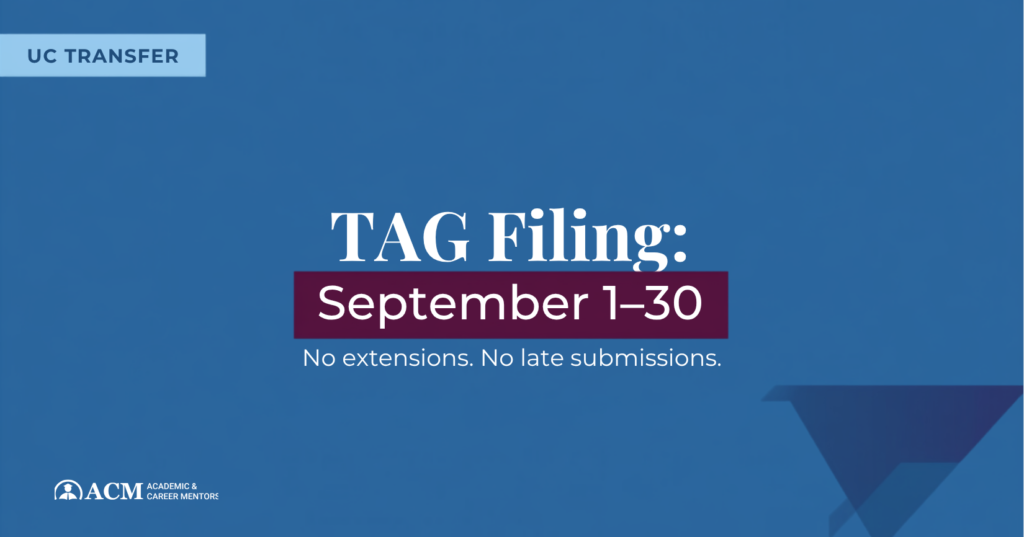
The TAG filing window closes September 30. For a lot of families, that date is when they discover the guarantee was never available to them — the campus they want doesn’t participate or the GPA minimum for their major was higher than they realized.
Roughly two out of three students admitted to UC as transfer students do not have a TAG. The guarantee is worth having if you qualify for it, but most admitted transfer students were admitted without one.
Why you might not have one
There are several common reasons.
The campus doesn’t offer it
TAG is available at six UC campuses: Davis, Irvine, Merced, Riverside, Santa Barbara and Santa Cruz. Berkeley, UCLA and San Diego do not participate in the program at all. If your target campus is one of those three, there was never a guarantee to apply for.
The GPA minimum for your major was higher than the campus minimum
TAG minimums are set by campus and by major, not by a single systemwide number. For the 2027-28 cycle, Irvine and Santa Barbara require 3.4 across all majors, while Santa Cruz sets 3.0 and several Riverside majors start at 2.7. Some campuses also set separate GPA requirements on major-preparation coursework.
|
Campus |
Minimum UC-transferable GPA (2027-28) |
|---|---|
|
Davis |
3.2 most colleges · Engineering 3.5 |
|
Irvine |
3.4 all majors |
|
Merced |
2.8-3.0 depending on school |
|
Riverside |
2.7-3.6 depending on major |
|
Santa Barbara |
3.4 all majors |
|
Santa Cruz |
3.0 all majors |
Source: UC’s 2027-28 TAG Matrix.
You’re in one of the excluded groups
The TAG Matrix excludes students who already hold a bachelor’s degree, students returning to the same UC campus they previously attended, students who were not in good standing when they left a UC, and students concurrently enrolled in high school at the time of submission.
What to focus on if you're not eligible
If you’re not eligible for TAG, that’s fine. Most students who transfer to UC do so without applying for TAG. The area of focus for students applying without a TAG is to make sure they complete all the campus and major eligibility requirements by the end of spring, and to obtain the highest GPA possible in fall, since the fall semester is the last semester UC uses to calculate the transfer GPA.
What UC asks of every transfer applicant
TAG or no TAG, the floor is the same. To be considered at the junior level as a California resident, you need 60 semester units (90 quarter units) of transferable college credit with a GPA of at least 2.4.
Nonresidents need 2.8.
You also need the seven-course pattern: two transferable courses in English composition, one in mathematical concepts and quantitative reasoning, and four more chosen from at least two designated subject areas.
UC is direct that this is a floor and not a finish line: “Completing the 7-course pattern alone is not sufficient for admission.”
Meeting the minimums gets an application considered. What a student shows beyond them is what decides it.
Where a no-TAG application is actually decided
Three things carry the weight. Most important is completing any required major preparation courses for admission; second is GPA; third is PIQs.
Major preparation. UC points transfer applicants to ASSIST to identify which community college courses transfer toward a specific UC major. This is the part of a transfer application that is hardest to fix late and does the most work when it’s strong — we’ve written about why major preparation often matters more than IGETC.
Your GPA overall and in that major coursework. UC states that campuses “will use your grade point average to make sure you’re adequately prepared for their courses.”
Your personal insight questions, specifically if you’re applying to Berkeley, UCLA, and UC Irvine. Four responses, 350 words maximum each — one required question about how you’ve prepared for your intended major, plus three of seven optional prompts. In our experience, the remaining campuses don’t really factor PIQs in the transfer admission decision. Along with your fall grades, this is the part of the application still in your hands in October and November.
The most common mistake
The biggest mistake is not meeting the major preparation requirements by the end of the spring term before transferring.
What to do between now and November 30
The UC application filing period runs October 1 through November 30, 2026. That is the window that matters now, and it is the same window for every applicant, guaranteed or not.
- Make sure you’re meeting all the major preparation courses by the end of the spring term.
- Focus on maximizing your GPA in the fall semester, since it’s the last semester UCs will use to calculate the transfer GPA.
- Make sure to complete and submit the application by November 30.
After you submit, the Transfer Academic Update opens and is due January 31, 2027 — that’s where you report fall grades and any schedule changes for spring.
Frequently Asked Questions
Does not having a TAG hurt my application? No. TAG is a separate agreement filed before the application; campuses that don’t participate never see one. Roughly two out of three admitted UC transfer students do not have a TAG.
Can I still apply to Davis, Irvine, Merced, Riverside, Santa Barbara or Santa Cruz without a TAG? Yes. TAG is optional, not an application route. You apply through the same UC application everyone else uses.
I filed a TAG at one campus. Can I apply non-TAG to others? Yes. UC Davis states you “can apply for general admission to as many UC campuses as you wish.”
Is there a late TAG option after September 30? No. The fall TAG filing period is September 1-30. Merced is the only campus that also accepts a spring TAG, filed May 1-31.
Do I need to complete IGETC to be admitted without a TAG? No. Cal-GETC/IGETC is not a TAG requirement at any campus except Merced Public Health, and it is generally not a minimum admission requirement.
Need help with your transfer application?
If you don’t apply for TAG, don’t worry. You still have a great chance of successfully transferring to a UC. If you need assistance with your transfer application, check out our transfer services here. If you’d like to discuss more about your situation, book a free initial consultation here.